What changed in October 2025
For most of the last two years, the most generous honest description of Kiantar was “built but not flying.” The West Sumbawa government’s own information portal classified it as a bandara khusus — a special-purpose airport — owned by Amman Mineral to support the Batu Hijau mine. Public commercial use was widely expected. There was no published timeline.
The 21 October 2025 operating permit changed the category. The airport went from potentially commercial to cleared for operations. That permit is what made the current Jakarta charter rotation possible. It’s also the prerequisite for the licensing steps that scheduled commercial routes need.
A regulator’s signature is what shifted the West Sumbawa property conversation in the last six months. Not a marketing campaign. A piece of paper.
Where is Kiantar Airport, Sumbawa?
Kiantar Airport sits in Kiantar Village, in the Poto Tano sub-district of West Sumbawa Regency (Kabupaten Sumbawa Barat, KSB), at the northwest tip of Sumbawa Island. It is right next to Poto Tano ferry terminal — until now, the way most travellers got onto Sumbawa from Lombok, on a 90-minute crossing.
Distances and times that matter:
| From / To | Distance | Time |
|---|---|---|
| Kiantar Airport → Rinjani Bay () (Kertasari) | ~20 km | ~30 minutes by road |
| Kiantar Airport → Taliwang (KSB capital) | ~25 km | ~30 minutes by road |
| Kiantar Airport → Maluk / Sekongkang | ~75 km | ~75–90 minutes by road |
| Kiantar Airport → Lombok International (LOP) | ~130 km | regional flight, when activated |
| Kiantar Airport → Bali (Denpasar / DPS) | ~280 km | ~45 min flight (mid-2027 anticipated) |
Who built Kiantar Airport, and does it matter?
It matters more than most marketing pages bother to mention.
The airport was commissioned by PT Amman Mineral Nusa Tenggara (AMNT) (), the operator of Indonesia’s Batu Hijau copper-gold mine. The general contractor was PT PP (Persero) Tbk , one of the country’s largest state-owned construction firms. The ground improvement work — the part that actually decides whether a runway can take commercial-aircraft loading on tropical-coastal subsoil — was done by Menard Indonesia, using Dynamic Compaction in the southern runway zone and Controlled Modulus Column techniques in the northern clay zone.
Plain English: the runway was engineered for commercial traffic from day one. It wasn’t a light airstrip with ambitions. The terminal is sized for ATR-series regional turboprops. Those are precisely the aircraft Wings Air and TransNusa fly on similar Indonesian regional routes. The infrastructure was built around the route map being assembled around it now.
One detail worth lingering on, because it shapes the risk picture later in this article. Kiantar’s commercial posture depends on AMNT’s continued commitment to the region. As of 2026 that commitment looks long-dated. AMNT formally commenced Phase 8 of the Batu Hijau mine on 13 May 2025, opening up an estimated 460 million tonnes of mineral reserves and extending the operational life of the site to around 2030. The AMMAN smelter adds another 222,000 tonnes of annual cathode copper capacity to the regional industrial footprint. AMNT is not winding down West Sumbawa. It is deepening into it.
Is Kiantar Airport operating now?
Yes — under its current permit. As of early 2026, three private charter flights a week move between Jakarta and Kiantar. These are not public commercial routes. They are scheduled charter operations, consistent with the airport’s licensing.
Two reasons this matters:
- The charters exercise the airport. Runway, terminal, ground handling, fuel, customs, crew rotation. Airlines watch this carefully when deciding whether to commit aircraft to a new route. Empty runways stay empty. Working runways attract schedules.
- The charters also build a baseline of regular controlled traffic, which makes it easier for the airport to add commercial slots without operational risk.
If you visit West Sumbawa in 2026, this is what “the airport is operational” looks like on the ground. Not a daily Bali shuttle yet. A working, permitted facility with regular movements. The next phase is the visible one.
When will Kiantar Airport have commercial flights from Bali?
Scheduled commercial service from Bali is anticipated in mid-2027, operated by Wings Air and TransNusa, on ATR 72-class regional turboprops. Estimated flight time: 45 minutes. Estimated launch fares: USD 75–100 one-way.
That date is anticipated, not contracted. It depends on airline route filings, regulatory approvals, ground-handling agreements, and demand forecasting — any of which can move. A realistic range is 12–24 months from the date of this article.
Wings Air is the regional turboprop subsidiary of Lion Air Group, which dominates Indonesian regional aviation. TransNusa has been actively expanding its Lombok and Sumbawa frequency and fleet capacity in recent route announcements. Neither is a fly-by-night carrier reaching for a frontier route. Both are the kind of operator that arrives once an airport is signed off and commercially viable.
After the initial Bali route, the comparable Indonesian pattern looks roughly like this. Bali daily first. Seasonal Lombok and Surabaya routes second. Year-round expansion third. Eventual international classification — typically Singapore and Kuala Lumpur first — somewhere in the 3–7 year window after launch. None of that is guaranteed for Kiantar. It’s the historical sequence for similar airports that did make the transition.
What did airport activations do to Lombok and Labuan Bajo land prices?
Two precedents are widely cited in Indonesian property analysis when discussing Kiantar.
- Lombok International Airport (LOP) opened in 2011. In the 36 months that followed, beachfront and near-beach land prices in newly accessible South Lombok submarkets — Kuta, Selong Belanak, the Mandalika corridor — rose by figures that industry sources commonly place in the 300–500% range. Wide variance by parcel. The shift from backpacker outpost to international resort destination, including the Mandalika MotoGP circuit and the wave of branded hotel investment that followed, dates from this airport activation.
- Labuan Bajo’s Komodo Airport expanded in 2015. The upgrade and subsequent international classification preceded a similar value shift. Land in the gateway town and along the harbour is commonly described as having tripled within the following 48 months. The market matured into one of Indonesia’s most active luxury-hospitality submarkets.
Two honest caveats. These figures are widely cited in Indonesian property reporting and broker commentary, but they are not from peer-reviewed real-estate data. Treat them as directional, not precise. And “tripled” is an average over a wide spread — some parcels did far more, some far less. Location, beachfront proximity, legal cleanness, infrastructure, all decisive.
What the precedent looks like in current numbers is more useful than the appreciation figures alone. Here is Lombok International Airport in 2025, fourteen years after activation:
| Lombok International Airport | 2011 (opening) | 2025 (full year) |
|---|---|---|
| Annual passenger throughput | ~0 (newly opened) | 2.497 million |
| Annual aircraft movements | ~0 (newly opened) | 26,337 |
That throughput is the destination state of an airport-driven activation curve. It is not a forecast. It is what an Indonesian regional gateway looks like once it has matured. Kiantar is at year zero of the same curve, with comparable coastal land quality on the Kertasari corridor.
Whether Kiantar travels the full curve depends on AMNT’s licensing posture, route economics, demand, and the regional tourism environment. The wider environment is currently working in Kiantar’s favour. NTB province as a whole recorded 2.09 million tourism visits in the first ten months of 2025, with foreign arrivals in October up 25% year on year. Regional momentum is real and rising.
So is Kiantar more like Lombok 2011 or like a smaller regional activation that produced modest gains? Our read sits closer to the Lombok pattern, for three reasons. AMNT-scale industrial backing is rare for Indonesian regional airports. Wings Air and TransNusa interest is materially stronger than the third-tier carrier interest some regional airports start with. And the coastal land quality on the Kertasari and Maluk corridors is comparable to South Lombok at its 2011 stage. None of those guarantees Lombok-scale appreciation. They make it a defensible base case rather than a stretch case.
What does this mean for West Sumbawa land prices in 2026?
Three things have already happened in the West Sumbawa land market, before any scheduled commercial flight has landed at Kiantar.
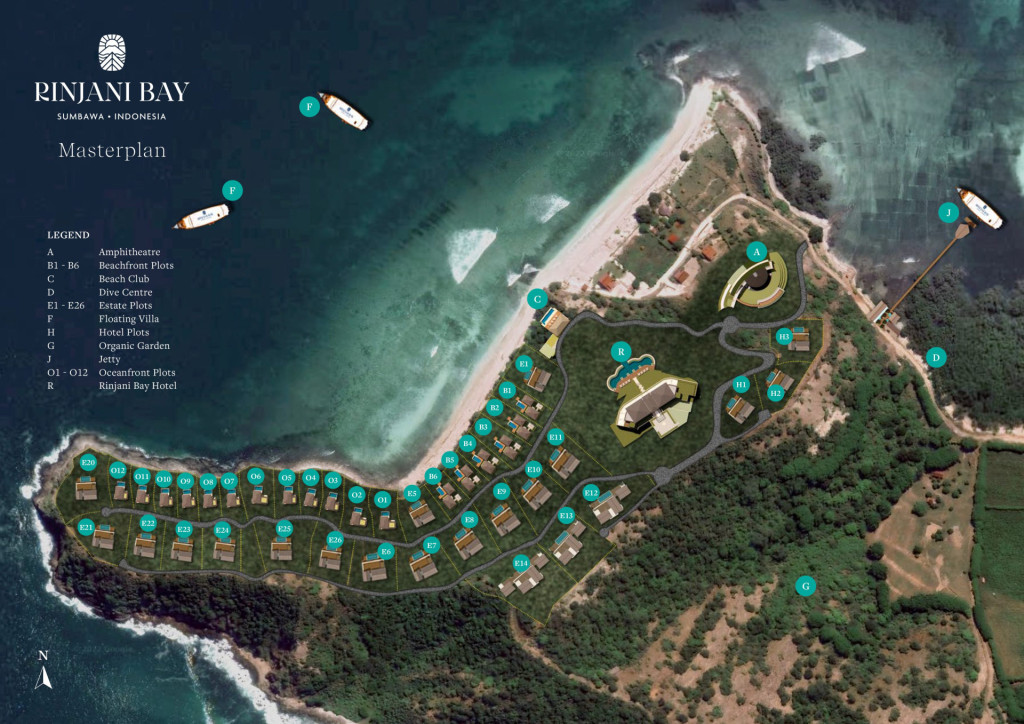
Master-planned coastal estates have started appearing along the Kertasari corridor where there were essentially none in 2022. Rinjani Bay’s 46-hectare estate is one example. Limited supply of suitable cliffside land, plus foreign-investment-friendly structures (PT PMA companies and long-term leasehold), has produced a small but active high-end submarket.
Land prices on the Kertasari coastline have moved up materially since 2022. Transaction-level data in West Sumbawa is sparse. Most figures are agent-reported rather than registered with the land office. We will publish a more detailed pricing comparison set when our 2026 Kertasari Coastline Comparable Set is finalised. Until then, treat any single-number “appreciation rate” with the same scepticism you would apply to a frontier real-estate market anywhere — including the high-double-digit annual figures circulated in some Indonesian property marketing material, which are typically self-cited rather than independently verified.
Tourism scouting has begun. Kertasari has emerged as a manta-ray diving and snorkelling destination, with a positioning aimed squarely at boutique and eco-conscious travellers (Native Indonesia, June 2025). A handful of boutique hospitality operators have publicly mentioned West Sumbawa exploration. Major international brand commitments have not been announced yet, and would, in most comparable markets, follow rather than lead the Bali route activation.
What hasn’t happened yet is also worth naming. The Wings Air or TransNusa scheduled service announcement. Mass-market resort development of the kind that reshaped Lombok’s south coast. The post-launch land-price step-up that comparable airports produced.
This is what a pre-commercial market looks like. The infrastructure is built and regulated. The route map is being drawn. The price step-up has not arrived because the price step-up follows the public flight schedule, not the operating permit. That sequence is not subtle, and it is not new.
The pre-commercial window: eighteen months, give or take
Drawn straight, the timeline looks like this:
| Date | Event |
|---|---|
| 21 October 2025 | Operating permit issued |
| Early 2026 | Jakarta charter rotation operating; you are reading this article roughly here |
| Mid-2027 (anticipated) | Wings Air / TransNusa commercial launch from Bali |
| 2028+ | Tourism volumes build; route expansion; broader hospitality commitments |
About eighteen months separates “you are here” from “scheduled commercial flights.” That window is the pre-commercial window.
The case for entering during it isn’t that the airport is secretly about to do something. The information is public. The case is that comparable Indonesian airport activations have produced their largest land-price step-up after commercial flights start, not before. Buyers who enter before the announcement typically pay materially less than buyers who enter after.
The risks to that case, which any honest version has to put on the table:
- The commercial launch can slip. Mid-2027 is a target window, not a contract.
- The initial frequency may underwhelm. Three flights a week from Bali for the first twelve months would still be transformative, but it’s a slower step-up than a daily-from-day-one launch.
- Airline economics shift. Wings Air and TransNusa decisions depend on broader fleet and route-network choices.
- Single-operator dependence. AMNT controls the airport’s commercial-use posture. The 2030 mine-life and ongoing smelter investment make that dependence less fragile than it would otherwise look — but it remains a single point of decision-making in a way that would be unusual for an investment-grade gateway airport elsewhere.
These are real risks. They don’t kill the thesis. They bound it.
Where Rinjani Bay sits in this picture
Rinjani Bay is a 46-hectare master-planned estate on the Kertasari cliffside, twenty minutes by road from Kiantar Airport. Plot pricing currently runs USD 83 – 84 per square metre, depending on position, view exposure and slope. That price includes core infrastructure delivery — paved internal roads, stormwater systems — plus legal documentation, notary fees, and applicable land taxes.
For context, comparable cliffside or near-beach land in established South Lombok submarkets currently transacts at multiples of that band, in some cases an order of magnitude higher. Bali Bukit cliffside transacts higher again. The price gap between West Sumbawa and Lombok or Bali coastal land is, in large part, a transit-friction discount. The thesis the Kiantar activation is testing is whether that discount compresses as the friction does. Gradually. Unevenly. With lag.
A serious buyer should not take that thesis on this article alone. The decisions worth real diligence — exact plot inventory, leasehold-structure mechanics, yield assumptions, comparable market data, exit assumptions — belong in a longer conversation with a named land-acquisition partner.